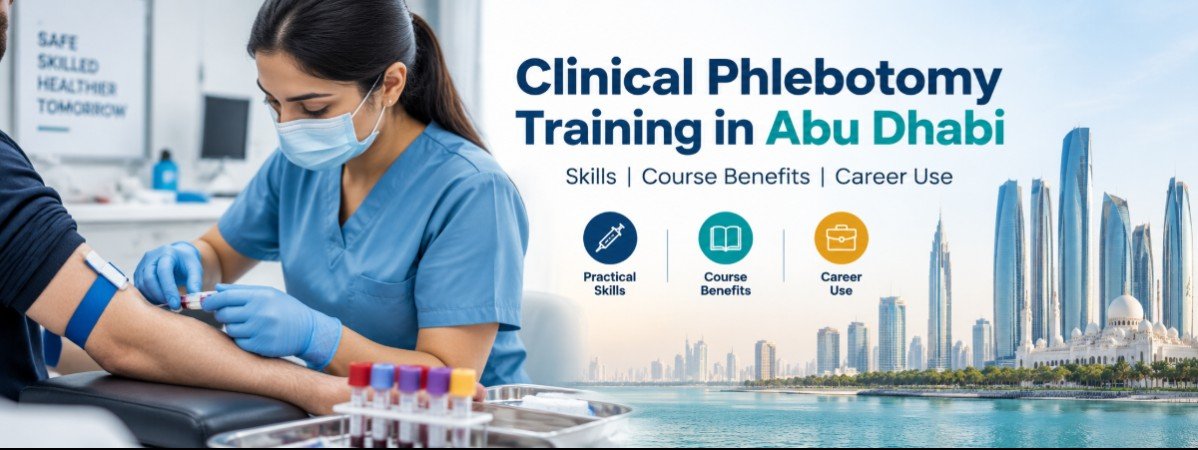
Most people think of blood collection as a simple routine procedure. For a trained healthcare professional, though, there is much more to it than just drawing blood. A patient might be nervous about needles. The right vein must be identified. Equipment has to be prepared properly, and the sample collected carefully, and then the tubes labeled correctly before they are sent for testing. Even a small mistake along the way can affect sample quality or patient safety. This is why proper phlebotomy training in Abu Dhabi can be valuable for people working in clinical and laboratory environments. It gives you a chance to understand the procedure properly and also practice it under supervision. If you are exploring medical courses Abu Dhabi, clinical phlebotomy is one practical area worth considering if blood collection is relevant to your work.
What is clinical phlebotomy training?
Clinical phlebotomy is the process of collecting blood from a patient for laboratory testing. It sounds very simple, but doing it well requires a combination of technical skills, patient care and attention to safety. Aphlebotomy course UAE typically covers what happens before, during, and after blood collection. You are introduced to venous anatomy, patient preparation, and equipment selection. You can also learn what needs to happen after the sample has been collected, including proper labeling and handling. There is also a strong security focus. Needles and other sharps have to be handled carefully and the collection process needs to follow appropriate infection control practices. If you are considering healthcare certification courses UAE, this kind of focused training can be useful because it combines clinical knowledge with practical skills that is used in many healthcare settings.
Who can benefit from a phlebotomy course in Abu Dhabi?
Phlebotomy training is especially relevant to people who already work or are preparing to work in healthcare environments where blood collection is part of the responsibilities. This can include laboratory technicians and clinical staff who might regularly deal with blood samples or patients requiring blood collection. If you are working in a laboratory , understanding how a specimen is collected is very important because the quality of the sample can have a direct impact on what happens later in the testing process. Phlebotomy courses in Abu Dhabi can be a useful way to build these practical skills in a structural learning environment. It is always worth checking whether the training matches your current role responsibilities and professional requirements.
Key skills covered in phlebotomy training
A good phlebotomy is about getting the procedure right from beginning to end. The needle insertion itself is part of the process.
Understanding veins and choosing the right side
You can become familiar with the basic venous anatomy and the factors that can influence site selection.
Preparing for the procedure
Before collecting a sample the equipment needs to be ready and you should be Appropriately ready. Taking a moment to explain what is going to happen can also help a nervous patient feel comfortable.
Venepuncture Technique
This is a hands-on part most people associate with phlebotomy. You can practice how to perform venepuncture safely.
Order of draw
When multiple blood collection tubes are required the order in which they are filled matters. You are introduced to the appropriate sequence and why it is important.
Specimen handling
Once the blood has been collected, the work is not finished. Samples need to be labeled correctly, handled and also transported properly.
Infection control
Save blood collection requires good hygiene practices and attention to preventing contamination and unnecessary exposure.
Sharp safety
Needles and other sharps must be handled and disposed of responsibly to reduce the risk of accidental injury.
Patient reactions
Some people feel anxious, dizzy or faint during blood collection. Training can help you understand these reactions and also respond appropriately.
Why infection control matters during blood collection
Whenever you are working with blood, infection control cannot be treated as an afterthought. Sometimes as basic as hand hygiene, is part of safe clinical practice. So is keeping equipment and the working area appropriately managed, handling specimens carefully, and disposing of used sharps correctly. There is another reason contamination can affect the specimen itself. The sample needs to be collected and handled in a way that helps you preserve its suitability for laboratory testing. This is exactly where the principles taught in the broader infection prevention and control course UAE program overlap with phlebotomy. Phlebotomy has its own specific techniques but infection prevention is a part of the bigger picture of safe patient care. The goal is simple: protect the patient, protect the healthcare worker and make sure that the sample reaches the laboratory in the right condition.
Why is hands -on practice important in phlebotomy?
Phlebotomy is one of those skills that is difficult to learn properly from theory alone. You can read about the venipuncture and understand the steps but actually performing the procedure requires practice. You need to get used to handling the equipment positioning the patient, locating the vein and carrying out the collection smoothly. There is also a human side of the procedure. A patient might be scared of needles or someone else might have difficult veins. Another person might feel faint halfway through the collection. These are the situations where communication and confidence matter just as much as technique. That is the only reason supervised practical training is valuable. You can practice in a controlled environment, receive guidance and understand where you need to improve.
Where Are Phlebotomy Skills Used?
Blood collection is part of many healthcare and diagnostic workflows, which means phlebotomy skills can be relevant across different types of clinical environments.
Depending on a person's role and qualifications, these skills may be used in:
Hospitals
Clinics
Diagnostic centres
Laboratories
Health screening settings
The exact responsibilities can vary widely from place to place. In some settings, blood collections might be a regular part of clinical professional duties while in others it might be more closely connected with laboratory or diagnostic work. It's important for you to not confuse learning skill with being guaranteed a particular job. Phlebotomy course UAE can provide relevant knowledge and practical training but employment requirements will depend on the role and the applicable professional Requirements.
ECG IV Cannulation and phlebotomy: how clinical skills support healthcare professionals
Healthcare involves a wide range of practical skills and professionals can choose different areas of training depending on their responsibilities. For example, ECG, IV cannulation and phlebotomy courses in the UAE might appear together when people are searching for practical clinical skills training. But these are unique skills.
Phlebotomy focuses on collecting blood specimens. ECG training relates to recording and understanding cardiac electric activity, while IV cannulation involves establishing Venous access for appropriate clinical purposes. If you are considering additional clinical training choose courses based on skills that actually relate to your role and the requirements of your workplace.
What to look for in a phlebotomy course in Abu Dhabi?
Choosing the right course isn't just about finding a convenient schedule. If you are comparing a medical training institute in the UAE start by looking at what you will actually learn and how much practical experience is included Unlock
A few things are worth checking:
Does the course cover venepuncture and specimen handling?
Is there supervised practical training?
Are infection control and sharps safety included?
Is there a practical assessment?
Are instructors available to guide learners during practice?
What type of certificate is provided?
Does the course content match your professional requirements?
Is the training environment suitable for practical clinical learning?
So you need to know that phlebotomy might be a routine part of healthcare, but doing it properly requires knowledge, technique, and attention to patient and specimen safety. Phlebotomy course in Abu Dhabi can help you develop these skills through a combination of clinical knowledge, practical training, and supervised assessment. If you are considering clinical phlebotomy training, you need to look for a course that gives proper attention to specimen handling, infection control, and patient care.